
TerraForums - Carnivorous Plant Community
You are using an out of date browser. It may not display this or other websites correctly.
You should upgrade or use an alternative browser.
You should upgrade or use an alternative browser.
Difference between N.arist x spect and N.spect. x arist.?
- Thread starter Zhilin
- Start date


lizasaur
Charlatan
You know, this post makes me realize that I know have to figure out which cross of a hybrid I want, cause I'm not gonna room for two of everything u.u'
HOW CAN YOU CHOOSE WHEN TWO PLANTS MAKE SUCH DIFFERENT RESULTS?!

I think I should just buy Borneo. I'm gonna need that much space.
HOW CAN YOU CHOOSE WHEN TWO PLANTS MAKE SUCH DIFFERENT RESULTS?!
I think I should just buy Borneo. I'm gonna need that much space.

carnivoure12
Hear the Call of Nepenthes
Maybe Oprah will let you use a section of her island.
Island!? She just bought mars, and she's terraforming it, you know what that is?, of course you don't, she invented it! I'm sure there's enough space on Mars for the plants

Back On topic though, this is a good reason for following the female first rule, other than knowing the sex of the each parent. that's why I like this system. Have you seen the light brokken

carnivoure12
Hear the Call of Nepenthes
Haha, no, it's a reference from a joke from debra wilson who does a great Oprah impression.
Although, there's something I know she definitely owns, Dr. Phil.
Although, there's something I know she definitely owns, Dr. Phil.
Can you guess which is thorelli x aristo and which is aristo x thorelli?
exhibit a:

exhibit b:

That's fantastic pitchers. I've never known the difference is so bigggg! Is the former thorelli x aristo and the latter aristo x thorelli?

Exo
Tastes like chicken!
You know, this post makes me realize that I know have to figure out which cross of a hybrid I want, cause I'm not gonna room for two of everything u.u'
HOW CAN YOU CHOOSE WHEN TWO PLANTS MAKE SUCH DIFFERENT RESULTS?!
I think I should just buy Borneo. I'm gonna need that much space.
Fine.....but I've got dibs on Sumatra.
That was my guess! *Crosses fingers and giggles with excitement and anticipation*Is the former thorelli x aristo and the latter aristo x thorelli?
Trick question actually. They are both thorelii x aristo - from the same seed batch actually. One female (the top) and the bottom is male - but it goes to show you that even the same cross, same parents and same seed batch can yield very different results. I personally don't subscribe to the idea that the female has a stronger influence on the offspring.
carnivoure12
Hear the Call of Nepenthes
Well, if the female things turns out to be a myth atleast we'll know which parent was which sex!
Trick question actually. They are both thorelii x aristo - from the same seed batch actually. One female (the top) and the bottom is male - but it goes to show you that even the same cross, same parents and same seed batch can yield very different results. I personally don't subscribe to the idea that the female has a stronger influence on the offspring.
That's interesting answer!

Can you guess which is thorelli x aristo and which is aristo x thorelli?
exhibit a:
exhibit b:
A: thorelli x aristo
B: aristo x thorelli
I could be wrong considering exhibit A is still small. But I don't think so..

i think the easiest way to look at this is via a bell/distribution curve.
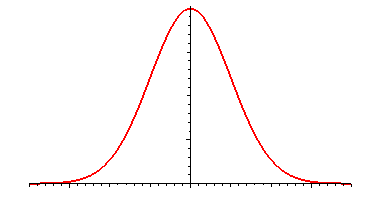
you have each parent on the either side and all the offspring fall within the curve.
very few offspring will look completely like either parent, but as you approach the center of the curve, the blending of both parents becomes more obvious. brokken's plants are an excellent example of showing variance amongst the same batch of offspring. in his case, one plant reflects the thorelli parent, and the other reflects the aristo.
you have each parent on the either side and all the offspring fall within the curve.
very few offspring will look completely like either parent, but as you approach the center of the curve, the blending of both parents becomes more obvious. brokken's plants are an excellent example of showing variance amongst the same batch of offspring. in his case, one plant reflects the thorelli parent, and the other reflects the aristo.