
TerraForums - Carnivorous Plant Community
You are using an out of date browser. It may not display this or other websites correctly.
You should upgrade or use an alternative browser.
You should upgrade or use an alternative browser.
Utricularia, section Orchidioides - info sharing & discussion

Something to do with invading rolons. I like it. Live sphagnum and it's anti microbial properties, and water regulation / evaporative cooling.

thanks so much for sharing Ron! i too am at that stage where root stolons are not advantageous for propagation, but i think my failure came from not keeping them constantly damp, and they were subjected to drying out many many times. T.T nice to finally see success! i take it quelchii will be making a plentiful debut next time around may?

I don't know about a minimal length - but most of the pieces were 1-3" long. The roots were originally placed in & among the pieces of live LFS so they had a lot of wet contact area & also access to light. When I'm watering the other plants, I add a little water to this small tray when it's no longer 'shiny'. When the water evaporates enough so only the moss is still wet, I add more. The location is not shaded at all - it's about 12-13" under T-5 lamps. As shown by their willingness to grow in the bottom of the tank (shaded & 20" from lamps), light intensity doesn't appear to be importatnt.Interesting, so let me make sure I understood it: the trimmed pieces (any minimal length?) of the roots were just placed on top of thin layer of sopping wet sphagnum in a shaded location?
In hindsight, I think I just needed to ensure the root fragments stayed in a thin film of water - I was originally keeping them too dry. I was also excited by the sheer number of little emerging leaves. For a plant that is mostly unavailable in the US, I found this very cool.

Yup - the NASC is always a good target to shoot for. For the potentially pickier plants, it's nice to divide them (or propagate them) now - so they have some time to get established before the auction. In addition to H. pulchella & heterodoxa - there may be a huberi & uncinata that find their way up for bids ...i take it quelchii will be making a plentiful debut next time around may?

Last edited:

boxofrain
does this rag smell like chloroform to you?
Looking over the pot where U. geminiloba grows in pure LFS, tonight I found this:
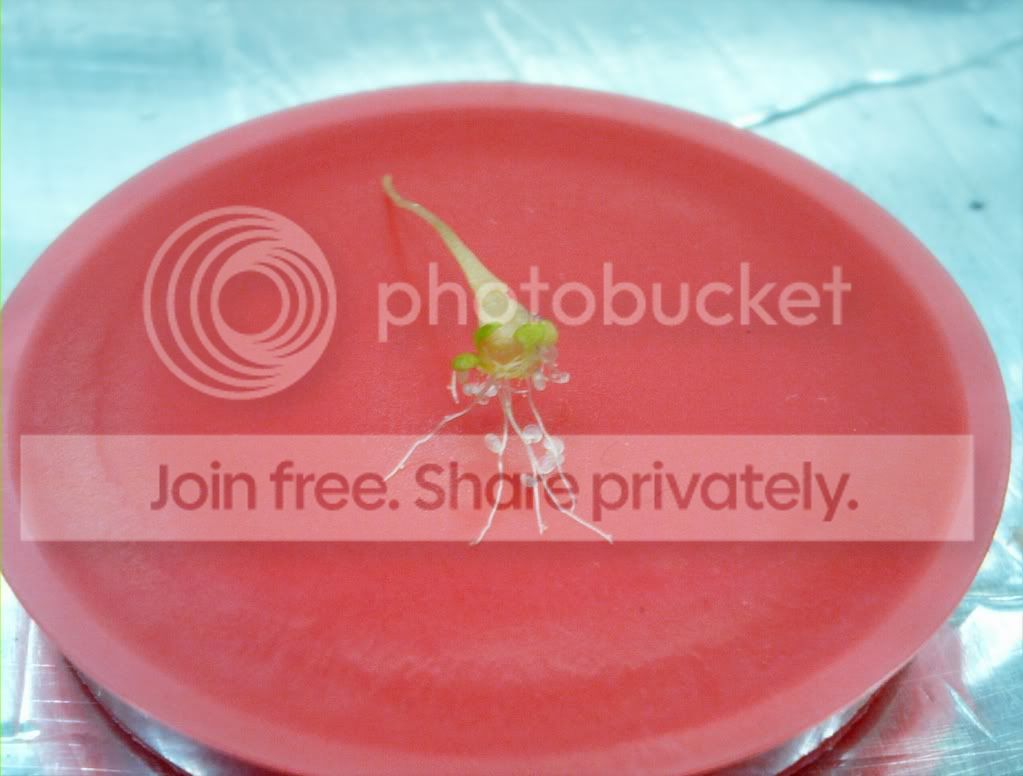

This leaf was broken off from the plant when I received it. It was covered with a thin layer of Sphagnum for about a month and a half.
very nice!
gill_za: very cool pics - thanks for sharing.
I'm very curious about people's success with this species. I've read numerous accounts of folk's having problems growing it. So far, mine has been a super-robust grower without odd idiosyncrasies. I believe RSS has had similar experience.

I'm very curious about people's success with this species. I've read numerous accounts of folk's having problems growing it. So far, mine has been a super-robust grower without odd idiosyncrasies. I believe RSS has had similar experience.
Are you thinking this is unusual?that was from a leaf? could have fooled me---looks like a tuber. congrats! you've successfully propagated an orchidioides utric from a leaf pulling!
This was my original 'safe' approach. However, sometimes the pot & root location required major effort to get into place. I also found that the approach didn't have 100% success (which was a real surprise!). I was pretty happy when I found how successful & easy just snipping off the roots & sticking them in wet live LFS ...Nice job! Very interesting method. I have left the "rolons" attached to the mother plant while "air layering" them in small cups of LFS in water trays. Once established, I "cut the chord".

Ron,
How long should the bits be left in wet LFS like that - until a few full adult sized leaves develop? Not that long? What if there are just a couple young leaves per strand - should they be left in the wet conditions longer? Will they tend to put on size faster in these conditions than being in a net pot of just moist live moss?
How long should the bits be left in wet LFS like that - until a few full adult sized leaves develop? Not that long? What if there are just a couple young leaves per strand - should they be left in the wet conditions longer? Will they tend to put on size faster in these conditions than being in a net pot of just moist live moss?
LOL! When I disturbed the little tray recently to send some pieces out, I was wondering the same thing.Ron,
How long should the bits be left in wet LFS like that - until a few full adult sized leaves develop? Not that long? What if there are just a couple young leaves per strand - should they be left in the wet conditions longer? Will they tend to put on size faster in these conditions than being in a net pot of just moist live moss?
 (I sure wish we could get Pyro back into these discussions!!) If I get some time this w/e, I'll transfer some over into pots and try to find out. However, based on what I found when I was digging in that little tray, I might be inclined to go against my instincts (& prior experience) & keep them in very wet live LFS for a while longer. There was a lot of growth in that little tray that was invisible from the top. I found that quite soon, there would be one solid mat of mixed rolons & traps all tangled together.
gill_za
Never Knows Best
gill_za: very cool pics - thanks for sharing.
I'm very curious about people's success with this species. I've read numerous accounts of folk's having problems growing it. So far, mine has been a super-robust grower without odd idiosyncrasies. I believe RSS has had similar experience.
Ron,
Out of the three Utrics you sent me last time, this one established itself the fastest. I originally set it up in two colonies (1: pure live Sphagnum, 2: milled lfs/sand/aps). Both seemed to grow at the same rate. Yesterday I transferred the above leaf and few stolons in Aps/Live_sphag/cypress_mulch/peat (3/2/1/1) mix just as an experiment. So I have 3 colonies of the plant at the moment. I'll update later on how the latest colony is doing.
It will be interesting to see your results. When I did a similar test, plants grew the same in both media for a while. After the initial period, the pure LFS pot just took off & it was no longer close. I found something similar with all of the original Orchidioides as well as U. nelumbifolia & humboldtii. U. reniformis & nephrophylla both did better in peat mixes for me.Yesterday I transferred the above leaf and few stolons in Aps/Live_sphag/cypress_mulch/peat (3/2/1/1) mix just as an experiment. So I have 3 colonies of the plant at the moment.
Imo, more people should do testing to see if they get similar results. My tests show very different results from Pyro so I'm wondering if my peat may have been an issue and also whether I'd get different results w/ U. nelumbifolia & humboldtii if I'd kept them on the drier side.

gill_za
Never Knows Best
I found something similar with all of the original Orchidioides as well as U. nelumbifolia & humboldtii. U. reniformis & nephrophylla both did better in peat mixes for me.
I can confirm this for nephrophylla. It doesn't grow as much in pure sphag as it does in peat based media in my conditions. I have also a similar experiment going for U. reniformis, but it is too early to tell anything definitive yet. I plan on trying it for every Epiphytic utric I have at some point.
Are you thinking this is unusual?
technically, it shouldnt, since i believe many utricularia have adapted to this kind of life strategy. for myself, cuttings of U. graminifolia floating in water when i trim my tank turn into plants, and settle in unwanted areas of the tank, ie: in my mini pellia, fissidens, etc.

for orchidoides, it should be no different, but i think there are specific conditions that need to be met in order to successfully take.

gill_za
Never Knows Best
for orchidoides, it should be no different, but i think there are specific conditions that need to be met in order to successfully take.
I have seen this happen to U. tricolor (not epiphytic) and to U. nephrophylla as well
Just kept the soil moist and plantlets started sprouting on the leafs in few cases.Some news to share with you guys concerning a couple orchidioides and pollination:
campbelliana DOES self pollinate!

that being said...it seems that cross pollination between two flowers seems to set more seed than pollinating a flower by itself. this could possibly be because the sex organs mature at different times?
but, on a sad note, quelchii does not self.
campbelliana DOES self pollinate!
that being said...it seems that cross pollination between two flowers seems to set more seed than pollinating a flower by itself. this could possibly be because the sex organs mature at different times?
but, on a sad note, quelchii does not self.
U. alpinia x U. nelumbifolia
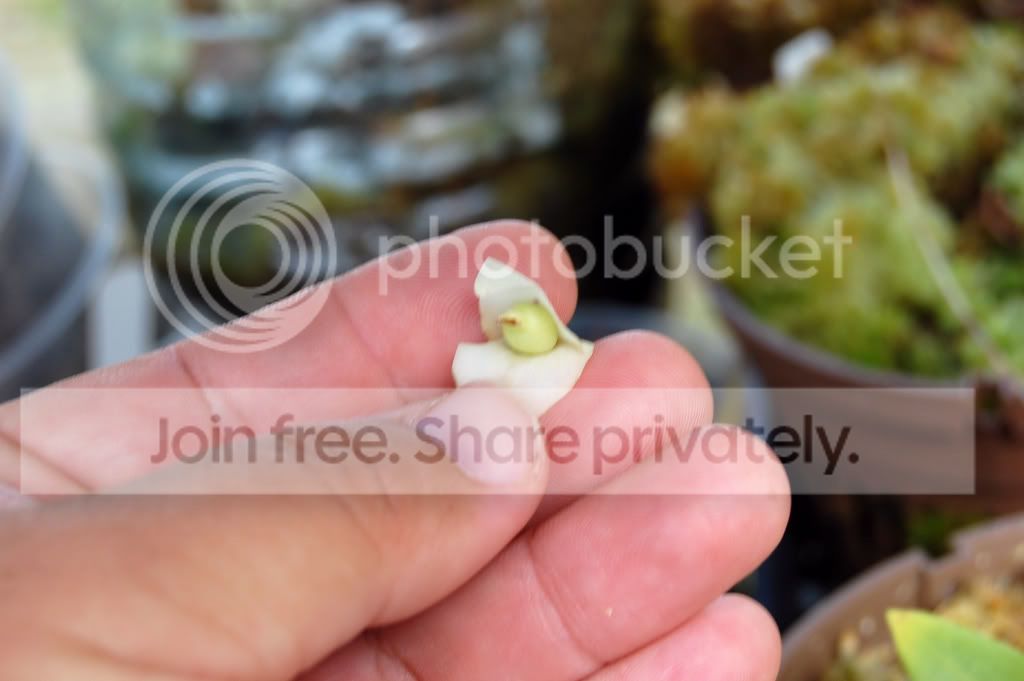
looks like ovary swelling
looks like ovary swelling
Wow - hadn't noticed activity in this thread and hadn't checked - doh!

Definitely some interesting stuff going on within this family of plants!
Agree. Sometimes Orchidioides leaves sprout easily and sometimes not at all. I'm not completely clear on what differentiates the two ...for orchidoides, it should be no different, but i think there are specific conditions that need to be met in order to successfully take.
Excellent news! Do you actually have seed & has it sprouted? I've had some asplundii x asplundii pollinations produce tons of seed - and yet none sprouted!Some news to share with you guys concerning a couple orchidioides and pollination:
campbelliana DOES self pollinate!
I wouldn't draw an overall conclusion yet. I'm seeing odd stuff happen with these plants (like the asplundii pollination mentioned above). Also, in Bob's photofinder, there are pics of a U. nelumbifolia x U. nephrophylla cross. I've tried this cross several times & never got anything. Herr Fleischmann has suggested that the smaller pollen tubes in U. nephrophylla may simply be unable to do the job --- but then I see these pics! (The reverse cross has worked twice for me - but with minimal seed set both times -- minimal but viable). I've also had a few other crosses that didn't work that made me wonder what's going on.but, on a sad note, quelchii does not self.
Sure does - I hope it's real (Pyro has had ovary swelling with zero seeds inside).looks like ovary swelling
Definitely some interesting stuff going on within this family of plants!