What's new
TerraForums - Carnivorous Plant Community

Welcome to TerraForums — a long-running carnivorous plant community established in 2001. Register for free to join the conversation, ask questions, and connect with growers from around the world.

NASC Auction will END in...

Review the rules :)
NASC auction is OPEN!!

Drosera Consevation

Hello, I am new here. I am writing a paper about the genus Drosera for my biology class and I was hoping that somebody could answer a few questions for me.

1. How endangered are Drosera plants in the wild?
2. How important is cultivation in conservation?
3. In your experience, what are the easiest Drosera to grow?

If you answer my questions, I would also like a name, email address, the number of years you have grown carnivorous plants, and the number of species you have grown so that I can cite you according to my teacher's specifications.
 
Alright, let us see here....
1. It really depends on the species. It can be argued that some of the widespread species, like D. anglica or D. rotundifolia, will not likely become endangered, while rarer species, such as D. regia, are more at risk because of a small range. However, in North America, bogs are quickly disappearing (Schnell, 2002 ;)).
2. In my opinion, cultivation is not the most important part in conservation. It is better to leave habitats unmolested and the plants where they are, because the wild is where they truly do belong. However, if a population is destroyed, cultivated material COULD be reintroduced... but again, it's just better to leave the plants where they are, without having to destroy their habitats in the first place.
3. The easiest Drosera to grow, IMO, are D. spatulata, D. tokaiensis, D. capensis, and D. adelae.


My name is Christopher Lew, I have been growing CPs for around 5 years (but really more like 2, because that's when I moved away from just flytraps), and I am currently growing 18 species and hybrids of Drosera. PM me for an email address.

:)
 
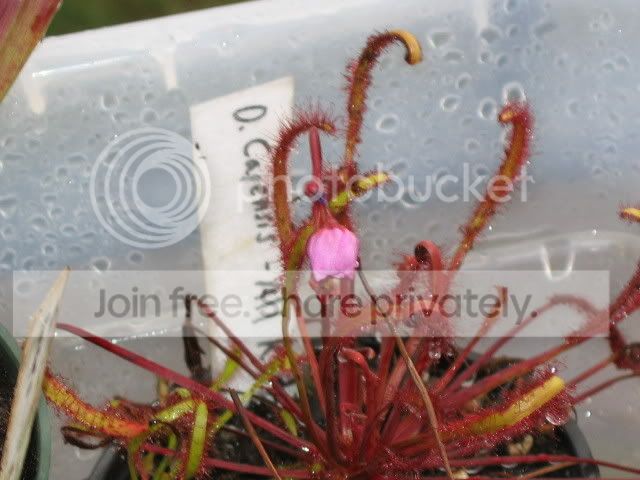
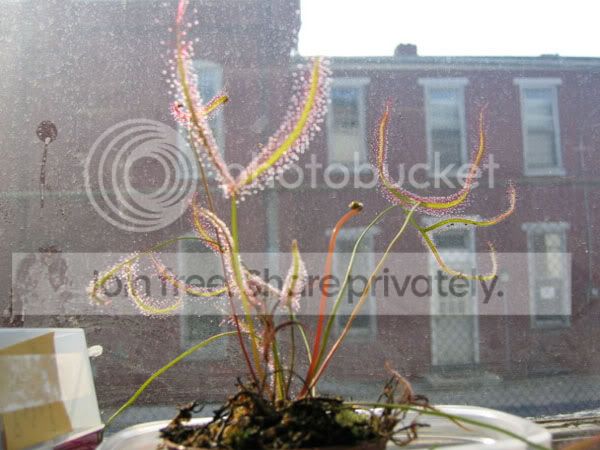
The easiest sundews to care for are D. capensis and D. binata.

IMG_0047-1.jpg
D. capensis


D_binata.jpg
D. binata
 
Back
Top