
TerraForums - Carnivorous Plant Community
You are using an out of date browser. It may not display this or other websites correctly.
You should upgrade or use an alternative browser.
You should upgrade or use an alternative browser.


Mobile,
Next time I go by my lab Ill pick up a small solar cell.... I'm sure its probably more sensitive to one wavelength or another, but it will be something. Ill compare its output with both light sources.
Might be a couple weeks, I'm on summer holiday and don't go by school much (its 72Km one way)
I do have the spectrometer at home, I'll get a picture using it.
Av
Next time I go by my lab Ill pick up a small solar cell.... I'm sure its probably more sensitive to one wavelength or another, but it will be something. Ill compare its output with both light sources.
Might be a couple weeks, I'm on summer holiday and don't go by school much (its 72Km one way)
I do have the spectrometer at home, I'll get a picture using it.
Av
Let there be light....
I wanted to use a heli but with using only one Tristar the close distance resulted in major shadowing.
I know some of the documentation says P. gypsicola prefers shade, I'll keep a eye on it for any signs of discomfort. However, its been on the top shelf of my plant rack and near my T5's since I got it a few weeks ago and seemed to be happy enough.
Plus it should be acclimated to high light levels.
Day 1
Pinguicula gypsicola...
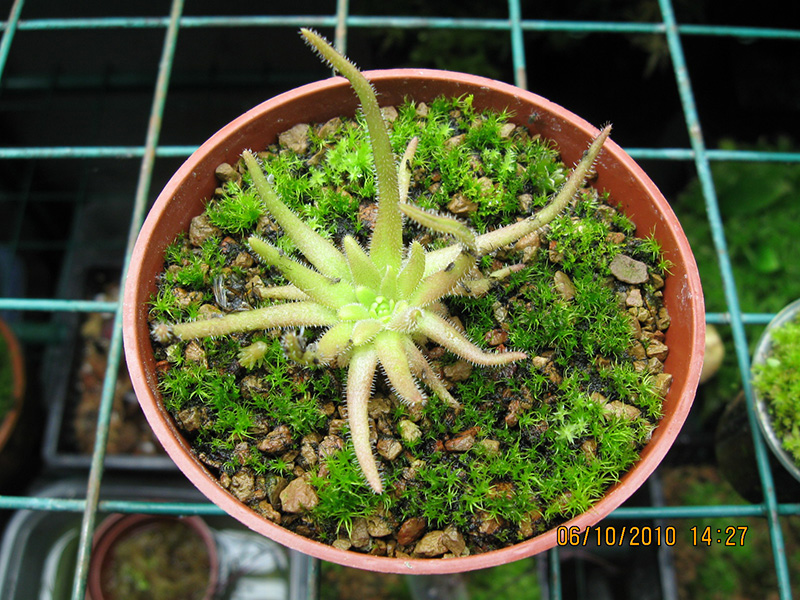
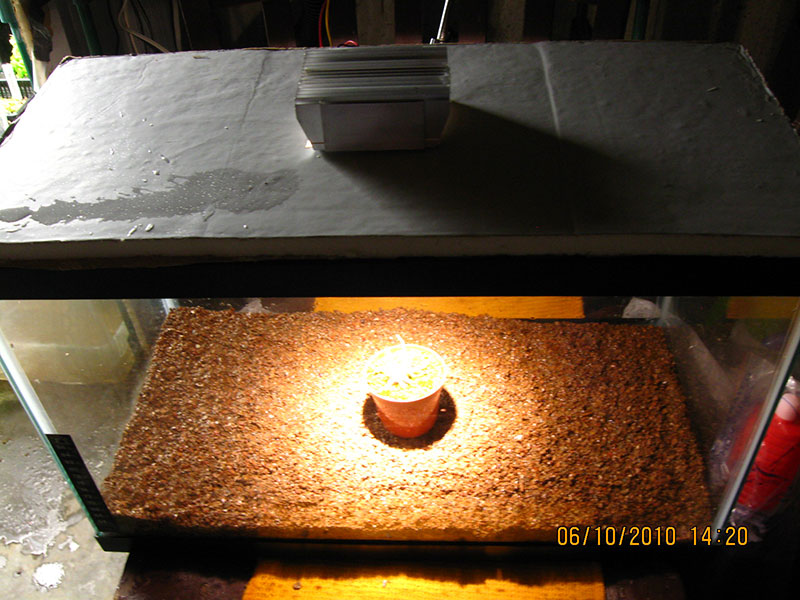
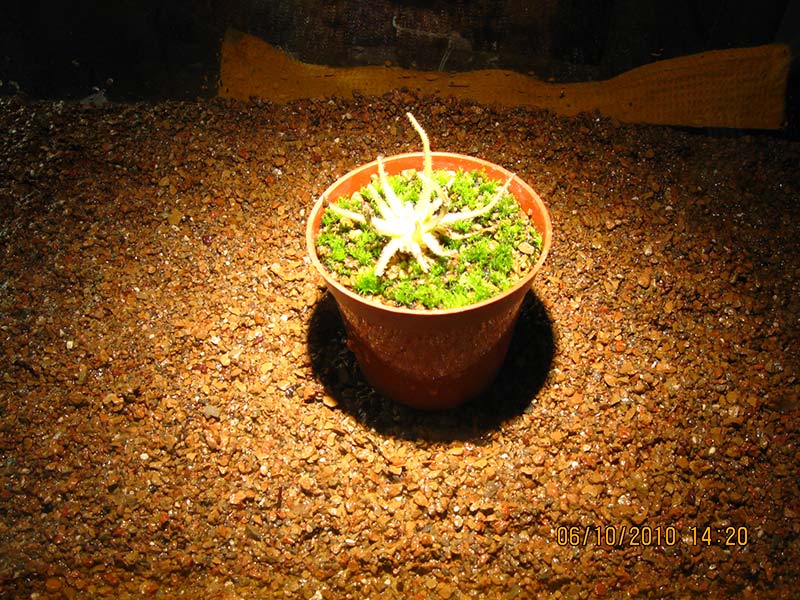
Obviously the camera is doing its best to compensate for the lighting, but notice the distinct shadow from the pot.
Av
I wanted to use a heli but with using only one Tristar the close distance resulted in major shadowing.
I know some of the documentation says P. gypsicola prefers shade, I'll keep a eye on it for any signs of discomfort. However, its been on the top shelf of my plant rack and near my T5's since I got it a few weeks ago and seemed to be happy enough.
Plus it should be acclimated to high light levels.
Day 1
Pinguicula gypsicola...
Obviously the camera is doing its best to compensate for the lighting, but notice the distinct shadow from the pot.
Av


Just a DIY tek clarification
Hello Butch,
You should use a 220uF, 50V electrolytic capacitor across the input leads.
Cheers!
Ron Warris
Luxeon Star LEDs
http://www.luxeonstar.com
On Wed, Jun 9, 2010 at 1:24 PM, <xxxxxxxxxxx@xxx.com> wrote:
Customers Name Butch
Question The PDF file for the buckpuck driver I purchased mentions using a capacitor if the power supply leads are over 15" long. It further mentions to be aware of polarity. I assume they are suggesting using an electrolytic but it gives no mention of the capacitors specs. I also assume the voltage rating would be something higher then applied voltage but what would be the suggested uf rating? Thanks in advance for your time in this matter. Regards,
Verification_Code XXXX
submit Question for Luxeon Star LEDs
Hello Butch,
You should use a 220uF, 50V electrolytic capacitor across the input leads.
Cheers!
Ron Warris
Luxeon Star LEDs
http://www.luxeonstar.com
On Wed, Jun 9, 2010 at 1:24 PM, <xxxxxxxxxxx@xxx.com> wrote:
Customers Name Butch
Question The PDF file for the buckpuck driver I purchased mentions using a capacitor if the power supply leads are over 15" long. It further mentions to be aware of polarity. I assume they are suggesting using an electrolytic but it gives no mention of the capacitors specs. I also assume the voltage rating would be something higher then applied voltage but what would be the suggested uf rating? Thanks in advance for your time in this matter. Regards,
Verification_Code XXXX
submit Question for Luxeon Star LEDs
Last edited:
Well after 3 days the ping lives LOL...
Initial observations:
Heatsink is about the right size, it gets warm to the touch... guessing 100-110f. Just for observable purposes the heatsink cools down almost instantly with a little airflow.
Once cool it also takes a bit to get hot again. Very pleased with that, operating temps seem excellent with passive cooling only.
Of course its only been three days but some growth can be seen.
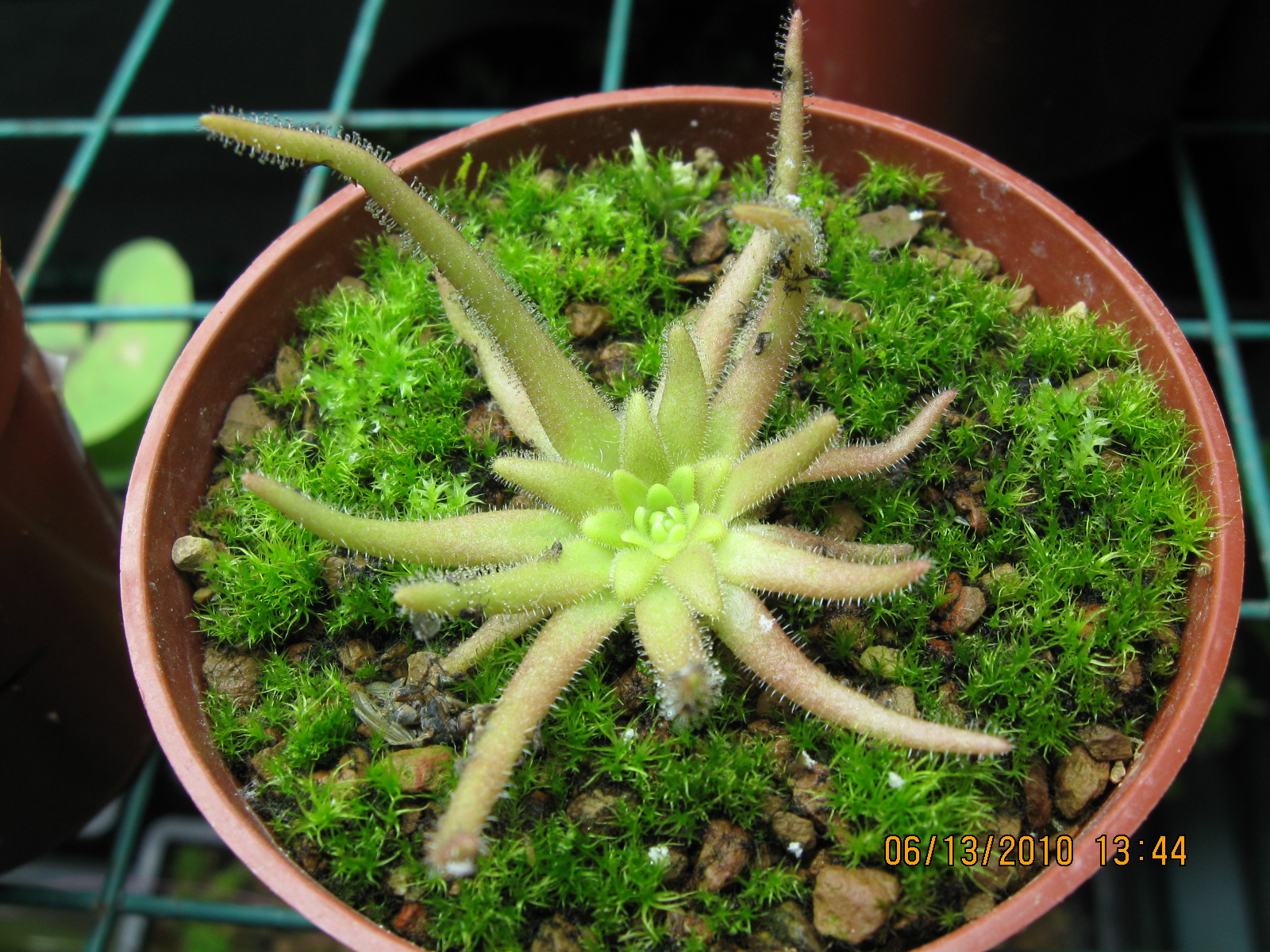
More obvious then that is an definite increase in the "sparkle" of the dew. It's even obvious from a distance.
Dew production has definitely increased.
Color does seem to have increased but at this point the difference is pretty subtle.
The big thing is so far the plant seems to like the light.
It's also important to remember this plant was already use to my T5's
Day 3 (sorry for the large image but its really required to see the detail)
Av
Initial observations:
Heatsink is about the right size, it gets warm to the touch... guessing 100-110f. Just for observable purposes the heatsink cools down almost instantly with a little airflow.
Once cool it also takes a bit to get hot again. Very pleased with that, operating temps seem excellent with passive cooling only.
Of course its only been three days but some growth can be seen.
More obvious then that is an definite increase in the "sparkle" of the dew. It's even obvious from a distance.
Dew production has definitely increased.
Color does seem to have increased but at this point the difference is pretty subtle.
The big thing is so far the plant seems to like the light.
It's also important to remember this plant was already use to my T5's
Day 3 (sorry for the large image but its really required to see the detail)
Av
I'm keeping a keen eye on this experiment. I like to have a 'feature plant' in my living room. Currently I achieve this by having a plant under a compact fluorescent but it would look so much nicer if I could have a nice spot source, such as an LED. I was considering using a 35W metal halide but this LED looks like it might be a viable alternative.
Mobile,
So far its pretty dang impressive. One thing I would do different would be get the 1000ma Buckpack driver. Since they have externally adjustable models in all three sizes (350ms/700ma/1000ma) there is really no reason not too. They are only a dollar or two difference in price. Even if you didn't use it, you would have the extra power there if you needed it. I don't think you could get by with passive cooling at 1000ma though. But you could probably get by with a low RPM/Low dB /Low Cfm fan. The light itself reminds me of the small halogens you see used in some of the nicer motel lifts... it does have "bling" and its a very nice "true" white light
Still much to learn before I would say jump..... but very promising. I just wish they weren't still so expensive. However, for the application you're considering, it could be the ideal light. After the trials I'm going to use mine in a similar application. (combined with my peltier experiments)
So far its pretty dang impressive. One thing I would do different would be get the 1000ma Buckpack driver. Since they have externally adjustable models in all three sizes (350ms/700ma/1000ma) there is really no reason not too. They are only a dollar or two difference in price. Even if you didn't use it, you would have the extra power there if you needed it. I don't think you could get by with passive cooling at 1000ma though. But you could probably get by with a low RPM/Low dB /Low Cfm fan. The light itself reminds me of the small halogens you see used in some of the nicer motel lifts... it does have "bling" and its a very nice "true" white light
Still much to learn before I would say jump..... but very promising. I just wish they weren't still so expensive. However, for the application you're considering, it could be the ideal light. After the trials I'm going to use mine in a similar application. (combined with my peltier experiments)
For large scale plant illumination then they would be too expensive but for a feature plant light it doesn't work out too bad. Was thinking a nice small glass shelf for a single plant and a box shelf above to mount the LED and driver. Low speed fan would be fine, I hardly notice the one in my HD digital satellite receiver/HD recorder so I'm not likely to notice another one.
I researched those the other day and went with the 120mm Scythe S-FLEX SFF21D, its only 8.7dB!!! and 800rpm IIRC, plus they are extremely reliable with the Sony mfg. liquid filled bearings, supposedly good for 150k hours of operation. They also have an excellent reputation.
I dug around and found them for just over 11USD each, and with ordering 5 I got free shipping to boot!!
(needed some for a rack upgrade too)
Newegg review
I dug around and found them for just over 11USD each, and with ordering 5 I got free shipping to boot!!
(needed some for a rack upgrade too)
Newegg review
Last edited:

Adam, give me a bit and Ill post exact links for ya...
http://www.luxeonstar.com/ANSI-White-4000K-20mm-Tri-Star-Rebel-255-lm-p/mr-4000-85-20t.htm
http://www.luxeonstar.com/700mA-Ext-Dimmable-BuckPuck-Driver-With-Leads-p/3023-d-e-700.htm
http://www.luxeonstar.com/Carclo-22-Deg-Frosted-Tri-Lens-With-Holder-p/10511.htm
http://www.dealextreme.com/details.dx/sku.4579
The driver module can drive up to 7 Leds (2 tristars)... each Led needs about 3.2vdc, so your dc power supply must be 3 or 4vdc greater then the sum of the LED's you plan on driving. (you wire the led's in series)
Example: I want to drive two tristars with one driver module
(6x3.2)+4 = required power supply voltage (Basically a 24vdc supply for 2 tristars, 12vdc for a single)
A generic regulated Apple laptop power supply on Ebay is 24vdc and about 12$
The heatsink is a common PC processor heatsink, buy those anywhere on the cheap... few dollars
The 5k pot and 220uf@35vdc capacitor is available at radio shack for a couple bucks..
But Adam, I don't know if the optic angle I chose is the best yet, I don't know if 700ma is the best.... everything is still unknown for our application. Most work in LED's for plant use has to do with red and blue, these high quality/High power whites are still too new to have much info out there.
But its fun learning.... and as mobile stated, for a small application the possibilities are awesome
http://www.luxeonstar.com/ANSI-White-4000K-20mm-Tri-Star-Rebel-255-lm-p/mr-4000-85-20t.htm
http://www.luxeonstar.com/700mA-Ext-Dimmable-BuckPuck-Driver-With-Leads-p/3023-d-e-700.htm
http://www.luxeonstar.com/Carclo-22-Deg-Frosted-Tri-Lens-With-Holder-p/10511.htm
http://www.dealextreme.com/details.dx/sku.4579
The driver module can drive up to 7 Leds (2 tristars)... each Led needs about 3.2vdc, so your dc power supply must be 3 or 4vdc greater then the sum of the LED's you plan on driving. (you wire the led's in series)
Example: I want to drive two tristars with one driver module
(6x3.2)+4 = required power supply voltage (Basically a 24vdc supply for 2 tristars, 12vdc for a single)
A generic regulated Apple laptop power supply on Ebay is 24vdc and about 12$
The heatsink is a common PC processor heatsink, buy those anywhere on the cheap... few dollars
The 5k pot and 220uf@35vdc capacitor is available at radio shack for a couple bucks..
But Adam, I don't know if the optic angle I chose is the best yet, I don't know if 700ma is the best.... everything is still unknown for our application. Most work in LED's for plant use has to do with red and blue, these high quality/High power whites are still too new to have much info out there.
But its fun learning.... and as mobile stated, for a small application the possibilities are awesome
Last edited:

Ron
Right now its about the same as it was with the t5...
Its at the bottom of a 10gal aquarium with the led level with the top
and I'm not so sure the inverse square law is as applicable in this application. For it to apply the area of the light beam has to double as the distance doubles, with concave/parabolic-ish type lenses/reflectors I'm not so sure this still applies.
It comes down to the geometry of the area over which the power spreads out. Let's make it easy for ourselves, and assume the power spreads out equally in all directions, in which case the area is the surface of a sphere Therefore at a distance r from the source, the power P of the source passes through an area 4πr2 - the surface area of a sphere radius r.
I = P/A = P/ 4πr2
so I ∝ 1/r2 (∝ = proportional to)
This is the inverse square part - square because the distance is squared, and inverse because intensity is proportional to one over distance squared.
So maybe its more correct in this application to say the intensity is reduced to 1/4, not when the distance is doubled as much as when the diameter of the beam is doubled. The inverse square law assumes this relationship is linear. The beam spreads at the same rate the distance is increased. Which would not hold true in this application.
ummm maybe, my brain hurts LOLOLOLOL
Right now its about the same as it was with the t5...
Its at the bottom of a 10gal aquarium with the led level with the top
and I'm not so sure the inverse square law is as applicable in this application. For it to apply the area of the light beam has to double as the distance doubles, with concave/parabolic-ish type lenses/reflectors I'm not so sure this still applies.
It comes down to the geometry of the area over which the power spreads out. Let's make it easy for ourselves, and assume the power spreads out equally in all directions, in which case the area is the surface of a sphere Therefore at a distance r from the source, the power P of the source passes through an area 4πr2 - the surface area of a sphere radius r.
I = P/A = P/ 4πr2
so I ∝ 1/r2 (∝ = proportional to)
This is the inverse square part - square because the distance is squared, and inverse because intensity is proportional to one over distance squared.
So maybe its more correct in this application to say the intensity is reduced to 1/4, not when the distance is doubled as much as when the diameter of the beam is doubled. The inverse square law assumes this relationship is linear. The beam spreads at the same rate the distance is increased. Which would not hold true in this application.
ummm maybe, my brain hurts LOLOLOLOL
Last edited:


Lenses do not ultimately negate the Inverse Square Law. What they do is alter the virtual position of the light source (opposed to the physical location). Measurements calculated from the virtual position will obey the Inverse Square Law.
A convex lens which focuses the light essentially moves the virtual position of the light source to the focal point in front of the lens.
Although this article uses a concave Fresnel lens in the illustration it doesn't take much imagination to substitute a convex lens.
http://www.portraitlighting.net/inversesquare_law.htm
A convex lens which focuses the light essentially moves the virtual position of the light source to the focal point in front of the lens.
Although this article uses a concave Fresnel lens in the illustration it doesn't take much imagination to substitute a convex lens.
http://www.portraitlighting.net/inversesquare_law.htm
Hehehehe I was looking for ya Warren 
I agree with you, but that is exactly my point... In your ref it makes this statement under exceptions: Sources that use optical or physical means to collimate light will not follow the inverse-square relationship, at least when based on their physical location.
Typically, decreases in light intensity as it relates to the distance from the physical location of the source is the application that we normally apply it to.
I'm just stating the same thing... ummm I think
In this application the auxiliary optics effectively collimate the light to some degree, therefore we cannot apply it as we normally would.
(In theory, if the light beams were perfectly parallel wouldn't its focal point be infinity? e.g., Lasers)
So doubling the distance would not have the same effect
I agree with you, but that is exactly my point... In your ref it makes this statement under exceptions: Sources that use optical or physical means to collimate light will not follow the inverse-square relationship, at least when based on their physical location.
Typically, decreases in light intensity as it relates to the distance from the physical location of the source is the application that we normally apply it to.
I'm just stating the same thing... ummm I think
In this application the auxiliary optics effectively collimate the light to some degree, therefore we cannot apply it as we normally would.
(In theory, if the light beams were perfectly parallel wouldn't its focal point be infinity? e.g., Lasers)
So doubling the distance would not have the same effect
Last edited:
Av,A generic regulated Apple laptop power supply on Ebay is 24vdc and about 12$
The heatsink is a common PC processor heatsink, buy those anywhere on the cheap... few dollars
I hadn't realised that you used a DC supply to feed the buckpack. Is there a reason why you didn't use an LED driving which can accept a 110Vac input, such as the one linked below?
http://www.stadiumpower.co.uk/uploads/SA10CC_STADSPEC_05112008.pdf
Good question,
I already have quite a few DC power supplies. With this in mind, it was cheaper to go with a low voltage driver module. Especially since I wasn't sure this would even work well.
Buckpack also has models with a 110vac input and there are other brands that do as well.
With an eventual goal of a HL/UHL centerpiece type setup with a 12v peliter it made even more sense. One of the power supplies I have is a nice Astron 12amp that I will probably use to drive the entire setup. Now I will only have two low voltage wires running to the setup.
Had I not had the power supplies and peltier to deal with, I would have gone with a 110vac driver module.....hmmm maybe LOL, there would still be the fans to deal with
Av
I already have quite a few DC power supplies. With this in mind, it was cheaper to go with a low voltage driver module. Especially since I wasn't sure this would even work well.
Buckpack also has models with a 110vac input and there are other brands that do as well.
With an eventual goal of a HL/UHL centerpiece type setup with a 12v peliter it made even more sense. One of the power supplies I have is a nice Astron 12amp that I will probably use to drive the entire setup. Now I will only have two low voltage wires running to the setup.
Had I not had the power supplies and peltier to deal with, I would have gone with a 110vac driver module.....hmmm maybe LOL, there would still be the fans to deal with
Av