What's new
TerraForums - Carnivorous Plant Community

Welcome to TerraForums — a long-running carnivorous plant community established in 2001. Register for free to join the conversation, ask questions, and connect with growers from around the world.

NASC Auction will open in...

Read the rules first :)
NASC auction is OPEN!!

Heliamphora sarracenioides update . . .

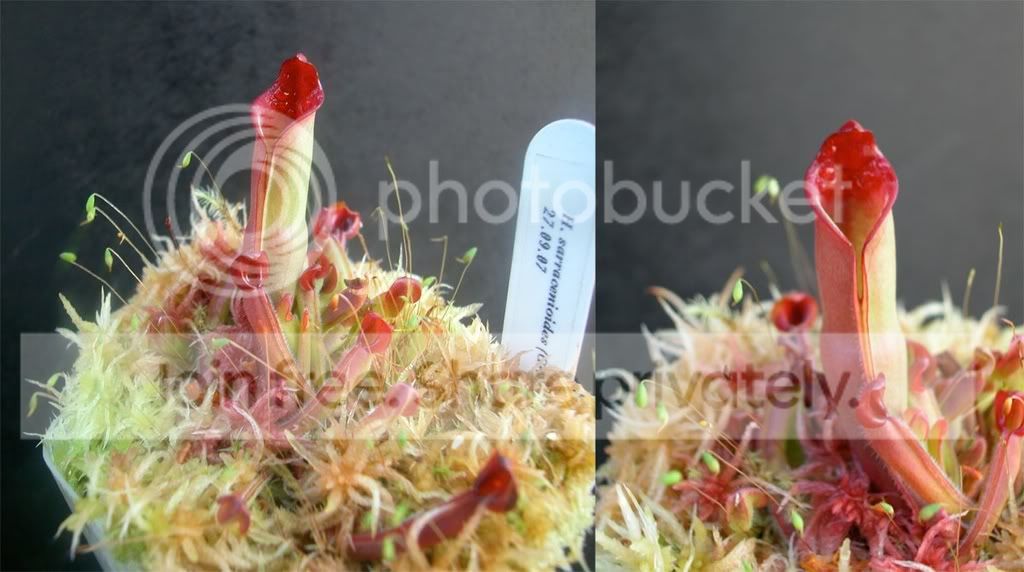
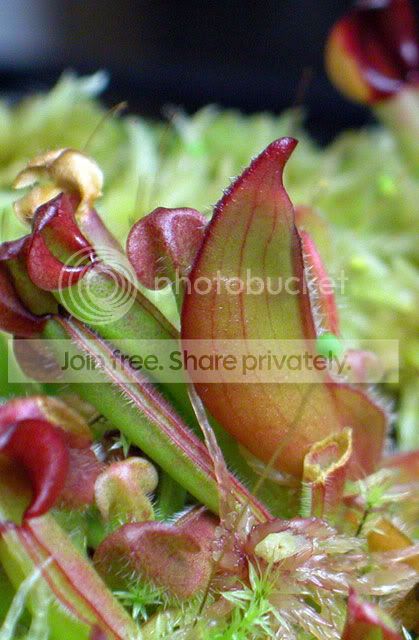
Here are a couple of images of a young Heliamphora sarracenioides, here producing its first mature pitcher -- a long time in coming. The first photographs show the plant in early November of 2008 or thereabouts; and the second set, from this week:

Heliamphora sarracenioides
Hsarracenioides.jpg
Hsarra.jpg

Hsarracenioides-1.jpg


It has been suggested by some at the CP UK site that many of the H. sarracenioides currently in cultivation are hybrids, presumably by judging the appearance of the first mature pitcher leaves. I seriously doubt that that is true, since there is a great deal of variability in shape, even among mature leaves in the wild, and also among plants that I've had for years. Wistuba, who described the plant in 2004 (http://www.carnivorousplants.org/cpn/Species/v34n1p4_6.html) also disputes this, since the plant (whose specific location and growing range remains "undisclosed" to avoid poaching) exists in rather isolated conditions . . .
 
Wow, those are very nice bella. The coloration is just incredible. What are your lighting and conditions that you grow these under. I currently have a H. minor that is doing well, but that is one of the more "forgiving" heli's! Thanks for sharing.
 
Very Beautiful Bigbella, are those the deeply colored type?

Thanks . . .

H. sarracenioides are deeply-colored in the wild, almost a purple-black in appearance. The link provided in the post has a few good images. Whether this will happen in cultivation remains to be seen. It is a bit too early . . .

In answer to another question, they were obtained a couple of years ago directly through Wistuba in Germany . . .

All of my younger plants are grown in terrarium settings under single 6400K Full-Spectrum Daylight Compact Fluorescents and later transferred outside when mature. The climate in Northern California suits them and highland Nepenthes . . .
 
Very nice! honestly I don't see the malformation of the captive plant's hood/nectar spoon compared to the wild adults. It just looks like a small version of the adults with a little change on how the hood's size. Any way, it sounds like a semi-mature trait being compare to a mature trait, like a mature bical's pitcher shape being compared to its taller semi-mature pitchers' shape.
 
Very nice! honestly I don't see the malformation of the captive plant's hood/nectar spoon compared to the wild adults. It just looks like a small version of the adults with a little change on how the hood's size. Any way, it sounds like a semi-mature trait being compare to a mature trait, like a mature bical's pitcher shape being compared to its taller semi-mature pitchers' shape.

That was exactly my point. What Heliamphora I saw in the wild (back in the early 1990s) varied a great deal, even among members of the same populations -- and it was thought to be associated with the amount of water they received, their degree of exposure, and various other factors, including temperature . . .
 
Back
Top