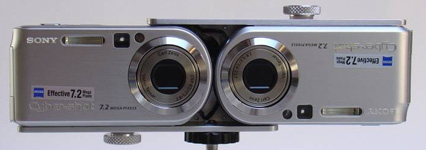
Hello all-- I made a "cross-eyed stereogram" (which forms a 3-D image if the viewer looks at the picture cross-eyed)--

--of my cephalotus today. I took two photos, the second one from a view several inches to the side, the first picture to represent the view from a left eye and the second picture to represent the view from a right eye.
Then I placed both photos, scaled, side by side in an image editing program (the Gimp, like PhotoShop (but free)), with the right-eye image on the left and the left-eye image on the right, so that when one views the two images cross-eyed, a third image forms in the middle that is a 3-dimensional composite of the other two.
Take a look if you like. It may take a little practice, and moving your face closer or further away from your computer monitor while staring cross-eyed at the image, to superimpose the two images onto each other creating the 3-D image apparently between the other two.
Link to 3-D cross-eyed stereogram of cephalotus:
3-D stereogram of cephalotus
Steve / xscd
--of my cephalotus today. I took two photos, the second one from a view several inches to the side, the first picture to represent the view from a left eye and the second picture to represent the view from a right eye.
Then I placed both photos, scaled, side by side in an image editing program (the Gimp, like PhotoShop (but free)), with the right-eye image on the left and the left-eye image on the right, so that when one views the two images cross-eyed, a third image forms in the middle that is a 3-dimensional composite of the other two.
Take a look if you like. It may take a little practice, and moving your face closer or further away from your computer monitor while staring cross-eyed at the image, to superimpose the two images onto each other creating the 3-D image apparently between the other two.
Link to 3-D cross-eyed stereogram of cephalotus:
3-D stereogram of cephalotus
Steve / xscd