What's new
TerraForums - Carnivorous Plant Community

Welcome to TerraForums — a long-running carnivorous plant community established in 2001. Register for free to join the conversation, ask questions, and connect with growers from around the world.

NASC Auction will open in...

Read the rules first :)
NASC auction is OPEN!!

Winter Dormancy in Michigan

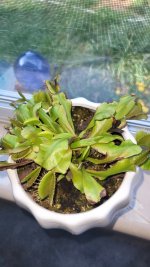
Hey guys, I have a venus flytrap I got in the spring. With winter coming up I was wondering when and how to put the flytrap in dormancy? Right now it seems even his new traps are turning black before opening (not sure if it's a problem or natural this time of year?) But it has me thinking maybe it's trying to go to dormancy as it isn't getting much light anymore and it's getting 55-60 degrees in the room it's placed in. Do any of you know of a good method for putting it in dormancy? And how would I know the difference if it has a problem or is just going into a natural dormancy?
 
Mine are outside, currently, and I don’t have any with blacking traps. Makes me think it might be a mineral buildup issue.

Mine will remain outside on my balcony until we start having hard frosts or nights with below freezing temperatures. At that point, they will be unpotted, dead leaves and traps removed (as well as any traps containing prey or the remains of such), wrapped in some barely damp sphag, put in a plastic bag, and put “to bed” in the fridge for the winter. (I do the same with the few Sarracenia I grow as nothing survives the winter on my balcony.)
 
Okay, there was a point which I did not water it and that's when the blackening started but that was over a month ago. I've been watering consistantly and always with distilled water since then and have been trimming off old dead traps. If it is mineral buildup should I re pot now?
 
I have successfully kept dormant flytraps indoors in a cool window and I just cut back on water and light until it warms up or they start growing more vigorously in the spring. Just keep the soil lightly moist, not wet as in growing conditions, and your plant should be fine.
 
I haven't had a VFT in a long time but I overwinter my Sarrs outdoors in CT and did the same with VFTs at least a couple winters. I don't know where you are but I'm in an area where the temp only rarely drops below 0F, meaning that most recent years it doesn't go below 0F. My process might not work in the colder places.

What I do is to set pots in the ground to within ~1" of the rim and cover them with tree leaves, at least several inches deep. Red oak leaves are ideal and be careful of maple leaves, which are prone to matting down and I believe they can suffocate whatever is underneath. Back when I had a lot more plants I would rig up a lean-to of landscape fabric over the plants to prevent much snow from piling up. I don't bother doing that anymore but do keep snow from piling up and I stir up the leaves now and then to keep them fluffly. The idea is to keep them from getting quite as cold as the coldest nights and to avoid freeze-thaw cycles. My Sarrs freeze but once they've frozen they stay frozen until they thaw. in the spring It works for my Sarrs and it worked for VFTs too back in the day.
 
Back
Top