What's new
TerraForums - Carnivorous Plant Community

Welcome to TerraForums — a long-running carnivorous plant community established in 2001. Register for free to join the conversation, ask questions, and connect with growers from around the world.

NASC Auction will open in...

Read the rules first :)
NASC auction is OPEN!!

Pygmy Drosera randomly dying

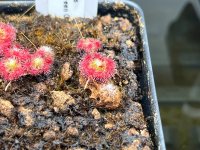
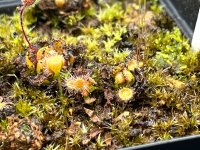
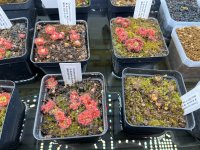
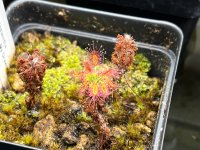
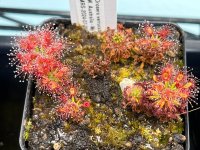
Most of my pygmy Drosera are doing well, but on occasion some of them turn brown and die.

Is this normal? Are they just reaching the end of their life span?

Or do you think there is a problem?

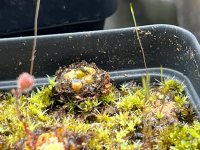
Additionally, a few of them have outer leaves black and the plant is curled up (I assume this may be a type of rest period or dormancy, but I'm not sure because they don't look healthy).

Any help would be appreciated
 

Attachments

  • MRS_20250123_004.jpg
    MRS_20250123_004.jpg
    233.5 KB · Views: 5
  • MRS_20250123_005.jpg
    MRS_20250123_005.jpg
    204 KB · Views: 5
  • MRS_20250123_006.jpg
    MRS_20250123_006.jpg
    220.2 KB · Views: 5
  • MRS_20250123_007.jpg
    MRS_20250123_007.jpg
    172.5 KB · Views: 4
  • MRS_20250123_008.jpg
    MRS_20250123_008.jpg
    223.4 KB · Views: 5
  • MRS_20250123_003.jpg
    MRS_20250123_003.jpg
    195.3 KB · Views: 5
I also have this happen - one or two pygmies 'failing to thrive' out of a pot full that seem fine. My own self-critique is that typically all the plants are of the same age, usually all started from a batch of gemmae, so it is not age-related. Rather, perhaps, conditions are not right for bountiful survival. PROBABLY, for my own conditions, I need to flush a bit more and pay attention to drier-preference species, than those that are less picky. I say 'probably' b/c I have not mastered pygmies, but do fine with many types. I'm trying heavier perlite/sand mixes because I also tray-grow as I'm seeing in some of your pics. Ideally (eventually) my plants will be in a more readily accessible grow area where I can flush, try short dry-tray periods, taller pots and expand to try more mixes, but I'm not quite there yet.

Still, I mostly have decent survival, and some seemingly happy pygmies. So - in short, I'm still learning too, but I always recommend starting a back-up pot from your own gemmae because there is (IME) some finicky-ness that I haven't appeased in my conditions, and it's good to try other methods and learn what works well/better in your conditions
 
I also have this happen - one or two pygmies 'failing to thrive' out of a pot full that seem fine. My own self-critique is that typically all the plants are of the same age, usually all started from a batch of gemmae, so it is not age-related. Rather, perhaps, conditions are not right for bountiful survival. PROBABLY, for my own conditions, I need to flush a bit more and pay attention to drier-preference species, than those that are less picky. I say 'probably' b/c I have not mastered pygmies, but do fine with many types. I'm trying heavier perlite/sand mixes because I also tray-grow as I'm seeing in some of your pics. Ideally (eventually) my plants will be in a more readily accessible grow area where I can flush, try short dry-tray periods, taller pots and expand to try more mixes, but I'm not quite there yet.

Still, I mostly have decent survival, and some seemingly happy pygmies. So - in short, I'm still learning too, but I always recommend starting a back-up pot from your own gemmae because there is (IME) some finicky-ness that I haven't appeased in my conditions, and it's good to try other methods and learn what works well/better in your conditions

Thank you so much for the insightful and helpful reply!

What you are saying makes a lot of sense, and gives me some things to think about.

I am not the best at maintenance, so I think insufficient flushing could be an issue. Flushing and changing tray water is such a hassle. There must be some clever ways of setting things up to make draining and changing water easier. Perhaps I'll make a new post to ask about idea for that.

I have never grown pygmies from gemmae before. I need to learn more about that. I did just read a quick article about it. I'm wondering what, in particular, triggers gemmae to form, and also how to tell the differences between gemmae and normal leaves which are just folded in the center before they open. I'm worried I might pull normal leaves off thinking they are gemmae. I just looked at my plants with a loupe and it appears that some of them may have gemmae, but some species don't. I guess each species is on its own schedule and reacts to conditions differently, as far as dormancy / gemmae production.

I have much to learn, but it will be easier with helpful folks such as yourself. Thank you again.
 
Ah - so you bought yours potted. Maybe there is also some experimentation to a mix that works well in your set-up that you can do once you have ample gemmae to play with.

In general, gemmae come in fall/winter. I say 'in general' because I have some plants that produce them almost year-round, and others that seem to be more seasonal. I don't really change up my culture at all seasonally ... since their grown under lights, and I don't really change their photoperiod, probably their biggest 'cues' are the ambient temperature dropping in the house in the winter, and my erratic care (which is erratic year-round). ;)

This is an old thread, but there is some good discussion on gemmae production - worth a review for folks 'experiences: how to get gemmae?

It's usually not too hard to tell gemmae from leaves, once they appear and are ripe. Some species are definitely more obvious than others. But, I have made the mistake you describe as gemmae production is wrapping up, and the plant starts producing carnivorous leaves again. Then those folded leaves can be a bit misleading. I usually just try and nudge the structure with my forceps first. Ripe gemmae are easily released, leaves less so.
 
Ah - so you bought yours potted. Maybe there is also some experimentation to a mix that works well in your set-up that you can do once you have ample gemmae to play with.

In general, gemmae come in fall/winter. I say 'in general' because I have some plants that produce them almost year-round, and others that seem to be more seasonal. I don't really change up my culture at all seasonally ... since their grown under lights, and I don't really change their photoperiod, probably their biggest 'cues' are the ambient temperature dropping in the house in the winter, and my erratic care (which is erratic year-round). ;)

This is an old thread, but there is some good discussion on gemmae production - worth a review for folks 'experiences: how to get gemmae?

It's usually not too hard to tell gemmae from leaves, once they appear and are ripe. Some species are definitely more obvious than others. But, I have made the mistake you describe as gemmae production is wrapping up, and the plant starts producing carnivorous leaves again. Then those folded leaves can be a bit misleading. I usually just try and nudge the structure with my forceps first. Ripe gemmae are easily released, leaves less so.

Another helpful reply, thank you!

Yes, I purchased them potted as shown in my photos.

Erratic care is very relatable. I have such a huge plant collection and am unfortunately somewhat lazy so it's just a hoarding nightmare situation.

I will be playing around with gemmae collection and substrate experiments this weekend. I will check out that link you shared for the other thread.

I did notice some of my plants have very obvious gemmae, so I'll start there and use the forceps trick.

I'll share updates in the future.

Thanks again!
 
Back
Top