What's new
TerraForums - Carnivorous Plant Community

Welcome to TerraForums — a long-running carnivorous plant community established in 2001. Register for free to join the conversation, ask questions, and connect with growers from around the world.

NASC Auction will open in...

Read the rules first :)
NASC auction is OPEN!!

Pinguicula that are fine with almost the same conditions (damp, very humid rock) year-round?

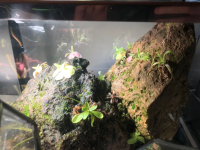
I have a couple of nice big chunks of mossy pumice in a small aquarium, not completely filled with water of course, and am looking to use them as ping rocks. Does anyone have any suggestions for plants that won't require me to make notable changes to their water and light levels? I would rather not have to worry about spotting when it's time to change things up. I can give them a slightly shorter photoperiod in the wintertime if that helps. Mainly it's the moisture I don't want to have to worry about, partly as I'll be growing D. adelae and possibly some others next to them.

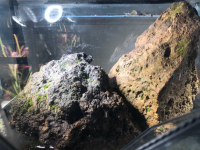
Photo attached. The tank is roughly the size of a shoebox tilted onto its side, perhaps an inch or two wider from front to back.
I'm still experimenting with water level, and currently have a range from 'slightly damp' to 'rather sodden' depending on location on the rocks.
That light in use is strong enough that I suspect I could grow a flytrap on that brightest face if the roots could take hold, but it loses strength rapidly from there. I can probably provide for just about any desired light level.
I plan to mount things directly onto the rock for the most part, with minimal to no sphagnum around the roots, except maybe the sundews in that crevice.
Currently the top is open, but I'll likely be adding a lid to reduce evaporation. I can add a computer fan to move the air around if I do.

One I know will work is P. emarginata. I'm not entirely sure if they can go dormant/resting/non-carnivorous, and they can definitely be grown with steady moisture year-round, as their natural habitat is moss next to waterfalls. The clump in my orchid terrarium has been thriving for about 4 years with no seasonal changes at all.

I've read that P. ibarrae only rarely shows its dry-period form, only when forced to, so it's on my definite list. P. gigantea would be, except that it's too large. I have a P. moctezumae I'm likely to use, though I'm trying to figure out if they need a calcium substrate. I have a P. x Naiad I'll be trying too, as I have a spare.

Some I'm very interested in are:
P. x Razzberry Blond
P. x Pirouette
P. agnata 'True Blue' (and probably other forms)
P. esseriana

I've also seen recommendations for:
P. ehlersiae
P. laueana
P. moranensis (especially interested in f. orchioides)
P. x Weser
P. x Sethos
P. x Johanna
P. x Florian
P. x John Rizzi

Would love to hear from anyone who's tried keeping any of these damp year-round. Would also like any suggestions for other species, though I do have a size limit- anything that gets significantly over 5" is definitely too large, unless it can be kept notably smaller by bright light. Would lastly be interested in hearing which of these require calcium; I have a chunk of limestone I'll be turning into a separate setup eventually, so they could go on there, but I don't think pumice has any available calcium for the pings to take. Could I put a few crumbs of limestone around the roots of one ping to benefit it without stressing the others?

Thanks in advance for any help.
 

Attachments

  • rockz.png
    rockz.png
    1 MB · Views: 7
You're looking for homophyllous Mexican species, or subtropicals like pumila, lusitanica, the hirtiflora group etc. Most of the plants you listed are not suitable because they do expect dry seasons and have winter rosettes for such (not dormant, just a separate growth habit). You might get away with agnata or some moranensis forms but they have winter rosettes as well.
 
Pinguicula gigantea. Not super beautiful pinguicula but very hardy. They're one of few that thriving in my tropic (equator) lowland conditions, for years. No significant temperature drop between day-night or seasons, always damp because its close to waterlogged farmlands, etc. Most my other pinguicula are at highland (most of them are mountains plants).


They'll produce many offshoots, loosely connected to motherplants by dried up stem or tangled dead leaves, and also aerial roots. In very humid climates, they could survive & grow just with aerials roots alone, and morning mist & dew.
 

Attachments

  • IMG_20231230_055538.jpg
    IMG_20231230_055538.jpg
    203.2 KB · Views: 6
You're looking for homophyllous Mexican species, or subtropicals like pumila, lusitanica, the hirtiflora group etc. Most of the plants you listed are not suitable because they do expect dry seasons and have winter rosettes for such (not dormant, just a separate growth habit). You might get away with agnata or some moranensis forms but they have winter rosettes as well.
Do you happen to know of a good source to find a list of those? Googling "list of homophyllous Mexican pinguicula" is mostly getting me results that include the phrase, rather than lists I can make use of.

Pinguicula gigantea. Not super beautiful pinguicula but very hardy. They're one of few that thriving in my tropic (equator) lowland conditions, for years. No significant temperature drop between day-night or seasons, always damp because its close to waterlogged farmlands, etc. Most my other pinguicula are at highland (most of them are mountains plants).
They're nice plants, and it's good to know they'll be fine in tropical conditions, but they do grow too large for this setup. Unless it's possible to keep them small in strong light?
 
Last edited:
Do you happen to know of a good source to find a list of those? Googling "list of homophyllous Mexican pinguicula" is mostly getting me results that include the phrase, rather than lists I can make use of.


They're nice plants, and it's good to know they'll be fine in tropical conditions, but they do grow too large for this setup. Unless it's possible to keep them small in strong light?
Ah probably no. At high humidity environment, pinguicula gigantea do grow large. Diameter of mature healthy p. gigantea at smallest are at still over 15 cm/ 6 inch. Well also depend on feeding (manual or by their own). They only grow smaller (10 cm across) at low humidity environments (e.g at my highland outdoor during dry season).
 
Most websites are going to group species by taxonomy rather than growth habit, but the species that are homophyllous and are also accessible in cultivation is a very, very short list: emarginata, gigantea, moctezumae, lilacina if you're lucky, zamudioana.
 
Jeff2 hit the nail on the head. Constantly moist conditions are exactly what warm temperate species from the SEUS such as lutea and coerulea prefer. And if it stays more towards wet than moist, primulaflora and planifolia are a good choice.
 
have you tried pings other than Mexican ones for example the US subtropical ones or the temperate ones in particular from Europe or even North America.
see here
other than Mexican but site in French
Honestly, I had assumed that "temperate" meant "rest period needed", and hadn't thought to look into these. That's very good to know, thank you.

Jeff2 hit the nail on the head. Constantly moist conditions are exactly what warm temperate species from the SEUS such as lutea and coerulea prefer. And if it stays more towards wet than moist, primulaflora and planifolia are a good choice.
There's a nice moisture gradient sloping down toward the water, with a portion right along the waterline that I would certainly call wet. It looks from a quick Google like most of these are short-lived perennials; is P. primulaflora the only one that will readily propagate itself in some fashion?
 
Most websites are going to group species by taxonomy rather than growth habit, but the species that are homophyllous and are also accessible in cultivation is a very, very short list: emarginata, gigantea, moctezumae, lilacina if you're lucky, zamudioana.
Short it may be, but that's a helpful list to have, thanks. Though, P. moctezumae is one I've been finding a lot of mixed information on; I see both people saying that it need a winter rest, and people saying it doesn't.

While I'm at it, do you happen to know if it needs calcium? I'm reading that it grows on calcium in the wild, but I see mixed opinions about if it needs any.
 
Honestly, I had assumed that "temperate" meant "rest period needed", and hadn't thought to look into these. That's very good to know, thank you.


There's a nice moisture gradient sloping down toward the water, with a portion right along the waterline that I would certainly call wet. It looks from a quick Google like most of these are short-lived perennials; is P. primulaflora the only one that will readily propagate itself in some fashion?
There are 2 different types of temperate Pinguicula, warm temperates from the SE US and cold temperates found further north and in Europe. Those are the ones that have a dormant stage, very similar to temperate Drosera. Primulaflora spreads like wildfire for me, forming new plants wherever a leaf tip touches substrate, while planifolia will occasionally form an offset from the crown.
 
There are 2 different types of temperate Pinguicula, warm temperates from the SE US and cold temperates found further north and in Europe. Those are the ones that have a dormant stage, very similar to temperate Drosera. Primulaflora spreads like wildfire for me, forming new plants wherever a leaf tip touches substrate, while planifolia will occasionally form an offset from the crown.
Looking planifolia up, my goodness are they tolerant of wetness. I'm finding photos of them blooming while submerged. I'll have to pick one of those up, and, if I can get it to propagate from a few leaf pullings, I may have to try growing one in the water as well as on the rocks. I'll also find myself a primuliflora- I assume they shouldn't be too difficult to tease loose of the rock if I wind up with too many?

Not pinguicula, but after seeing the in situ photo in this article, I've gone for a D. aliciae as well. A fair number of sundews seem to grow this way at least occasionally. I suppose there's no reason they wouldn't, if they happened to get a foothold. Heck, I've seen prickly pear cacti, a much larger, much heavier plant that has no ability to catch food, growing as epiphytes and lithophytes in the tiniest pockets of debris on trees and cliffs.
 
Word of warning about the above suggestion: the warm-temperate US species need a winter season change too in order to stay healthy long-term. It's not a drastic change needed, but if you want to see flowers reliably and not have them start collapsing after a year or two, temps need to drop into around the 50's-60's F at least for a few weeks, with a somewhat shorter photoperiod. They grow alongside the obligately dormant Sarracenia, Drosera, and semi-obligate Dionaea after all.
And other than that all plants, because they are living organisms, need calcium in some amount to survive, I don't know that there are any that obligately need to grow on a calcium-rich substrate. For those more likely to grow in such a place (research individual species is your best option to figure which ones do), gypsum powder is easily enough accessed, and I do sprinkle it occasionally in some of my pots. And P. moctezumae is a homophyll, it does not experience changes in leaf structure or significant changes in moisture in its environment. It grows in permanent seeps.
 
I can certainly take a swing at a mild temperature change, and I'll be doing a shorter photoperiod anyway for the sake of whatever on the rock needs a seasonal indicator to bloom. I certainly hope nothing in here will mind something of a temp drop, because I live in a house that was built before the invention of insulation and I have four windows letting all my heat out. As much as a terrarium helps, winter will be cooler, though I may have to move it to get it to stay in the 50s-60s. Will keep an eye on that, and probably just get the primuliflora for now- it's much more common and less expensive.

I have some small fragments of coral skeleton (limestone, calcium carbonate) intended to be put in shrimp tanks to provide them with calcium. Do you suppose I could put a few pieces directly under some of the pings for them to make use of without stunting the sundews growing elsewhere on the rocks? I may have to test that.
 
in fact for the Mexicans and the temperates they need a period of dormancy but not for the same cause for the first rather a period corresponding to droughts (hence their succulent leaves at this period), for the latter rather a period corresponding to the negative cold temperatures of winter

P.moctezumae when it supports European temperate conditions well like P.longifolia or P.vallisneriifolia (except of course frost)

see here their 'in situ' conditions :Postcard_25

you live in what country FISHKEEPER ?
 
Last edited:
I'm in the US. Specifically, Texas, so I'm right above Mexico. These will be grown indoors, though.

Lovely photos there!

I grow a few pygmy drosera, which are Australian. They have a summer dormancy in the wild, when it's especially hot and dry, but they actually do better in cultivation without the dormancy; it's stressful for them. So I wonder, is it the same for the pinguicula that normally have a dry summer rest?
 
Texas seems to have several types of climate from very arid to more tropical southern Mediterranean.
What city or town are you from? and what climate do you have?
in Texas "in situ" it seems that there is only one species of ping: P.pumila
 
Central TX is fairly arid without being all the way to the almost desert-like environment you see in post cards and movies, but I'm not sure the climate outside my house matters? Like I said, I'm growing these plants indoors, in a terrarium. They have artificial light.

zingbox.png
Here's what I have on the rocks as of now. I'll probably stick with this rather than adding much of anything else, at least unless/until something does poorly and has to be removed.
P. ibarrae, P. 'Razzberry Blond', P. 'Pirouette', and P. emarginata on the shorter gray rock.
Two emarginata hybrids, alongside P. 'Naid', and P. moctezumae on the taller. The moctezumae is bedraggled from drying out in its holding pot. I may move it lower, or onto another setup entirely- I had a hard time finding it a spot that looks good.
The crevice between has D. adelae, D. aliciae, an unlabeled bladderwort that I believe is one of the more epiphytic varieties based on its leaf shape, a marcgravia (vine), and a miniature begonia species hidden at the back.
The P. primuliflora I got was too large to really fit anywhere, so I pulled all its plantlets loose and arranged them around the lower edges. The largest one is at the bottom of the crevice. I have placed one completely in the water to see if it can grow entirely submerged. The adult will probably go into a sarr pot to see if it does well.

I'll give them a photoperiod that varies seasonally, longest in summer and shortest in winter. If anything other than the primuliflora decides to go into its resting period, I'll either remove that plant and put it elsewhere, or reduce watering slightly. I've placed the ones more likely to do that higher on the rocks, so I can keep the rest moist. Primuliflora doesn't appear to need a drier period for its rest, since it grows in conditions that can only be described as "sodden".
 
Back
Top