

I've had both grandiflora and vulgaris pollinated in my outdoor bog (not sure how)- also some OP mexi pings. I did (last year) see a hummer visit a few mexi ping flowers, so that *might* have been the culprit. I'm trying to get better at sowing ping seed, so try and keep an eye out for any forming pods. I don't always get them at perfect ripeness, and have had pods 'spill'. Practice makes perfect.
TerraForums - Carnivorous Plant Community
You are using an out of date browser. It may not display this or other websites correctly.
You should upgrade or use an alternative browser.
You should upgrade or use an alternative browser.
Pinguicula macroceras Breeding
- Thread starter FrankenSnyder
- Start date

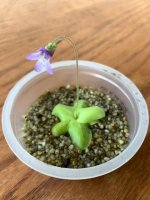
Photo shot today. Flowering again and growing much better this time. I gave a longer dormancy, 5 months, replanted in different gravel, and have been foliar feeding liquid fertilizer formulated for acid loving plants with a syringe. Grew amazingly fast from winter bud to flowering. My love is restored.

I spoke too soon. Once again the flower turned upwards, and has made no pollen. Even more strange, the flower has 4 stamens.
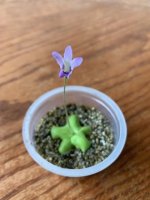
Jeff, my plant’s flower has a long spur, so I call it macroceras. Yes, P. x scullyi is a beauty. Too bad it is sterile. I know how we could make a fertile hybrid, but that would take a lot of work.
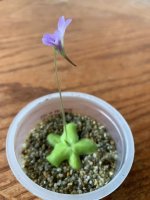
Jeff, my plant’s flower has a long spur, so I call it macroceras. Yes, P. x scullyi is a beauty. Too bad it is sterile. I know how we could make a fertile hybrid, but that would take a lot of work.
Last edited:
From Northern California.
More breeding I’d like to do: Cross my plant with a more typical vulgaris. See in the photos how my Northern California plant has outward curved leaves. I believe this leaf shape must be an adaptation for helping the plant cling to the notoriously slippery wet vertical Serpentine rock surfaces of the region. This leaf shape does not hold liquid fertilizer well.
More breeding I’d like to do: Cross my plant with a more typical vulgaris. See in the photos how my Northern California plant has outward curved leaves. I believe this leaf shape must be an adaptation for helping the plant cling to the notoriously slippery wet vertical Serpentine rock surfaces of the region. This leaf shape does not hold liquid fertilizer well.

Thanks for your interest Jeff. Yes, lots of variation around the world in the vast range of this species. Others have earlier suggested P. balcanica with its 32 chromosomes may be ancestral to vulgaris. If so, I figure balcanica would be better taxonomic organization treated as a subspecies of vulgaris. For absolute proof, balcanica with doubled chromosomes could be crossed with a natural vulgaris having 64 chromosomes.
I have another flower, opened today. Turned upward again. I’m eager to see if this one too will have 4 stamens.
I have another flower, opened today. Turned upward again. I’m eager to see if this one too will have 4 stamens.
Thanks for your comments Bluemax, I know how you like growing grandiflora. Easy little plant for you to grow. Wouldn’t be a bad idea to cross balcanica and grandiflora.
Donald Schnell’s CP book mentions an un-named butterwort in Washington State. I figure it is probably an alpine form of vulgaris. Bluemax and I have discussed this. Smaller rosette, smaller flower, and shorter flower stalk. Much like balcanica.
Donald Schnell’s CP book mentions an un-named butterwort in Washington State. I figure it is probably an alpine form of vulgaris. Bluemax and I have discussed this. Smaller rosette, smaller flower, and shorter flower stalk. Much like balcanica.
see here france the location of P.vulgaris subsp vulgaris in USA
To my knowledge there is no vulgaris on this side of the USA except in Alaska.
see also here for P.macroceras https://www.sarracenia.com/pubs/cpn40-44-49.pdf
P.macroceras in USA
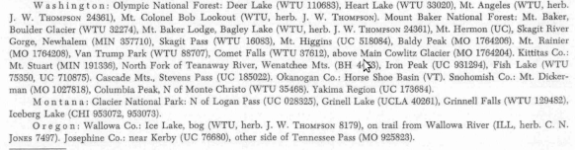
P.vulgaris in USA

To my knowledge there is no vulgaris on this side of the USA except in Alaska.
see also here for P.macroceras https://www.sarracenia.com/pubs/cpn40-44-49.pdf
P.macroceras in USA
P.vulgaris in USA
Last edited:
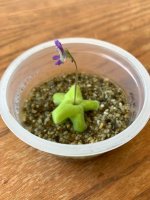
Photo shot yesterday: P. vulgaris malformis, Castile de FrankenSnyder, Southern California. Note odd shaped flower with short spur.

Lots of interesting plants have come out of the old castile over the years. The colors seem more brilliant in the flower this time.
Interesting that Washington State seems to have the dominant number of sightings of P. vulgaris in the US. I suspect that Oregon has as many plants but that is just a guess. I had no idea it existed in NE US states as well but that jibes with it growing in western Europe. Thanks for the info, Jeff!
Interesting that Washington State seems to have the dominant number of sightings of P. vulgaris in the US. I suspect that Oregon has as many plants but that is just a guess. I had no idea it existed in NE US states as well but that jibes with it growing in western Europe. Thanks for the info, Jeff!
Macroceras and vulgaris are two different species.
.Here is their distribution in the northern part of the globe; P. vulgaris in gray; P. macroceras in the other part.
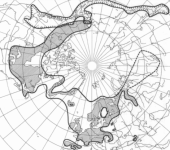
P. vulgaris is widely distributed in Europe in various subspecies.In France, we know of two species that, unfortunately, with global warming, are disappearing from the plains to the mountains.
.Here is their distribution in the northern part of the globe; P. vulgaris in gray; P. macroceras in the other part.
P. vulgaris is widely distributed in Europe in various subspecies.In France, we know of two species that, unfortunately, with global warming, are disappearing from the plains to the mountains.
Thanks Bluemax and Jeff, the geographic range is interesting. I wish they grew closer by here in Southern California so I could study them more in the wild. I have planted California Butterwort in the wilds around here. A few grew fine till slugs found them. During the last Ice Age there probably were pings here. At the La Brea Tar Pits remains of redwood and cedar trees have been found. Trees now further north along with butterworts. These trees are now being planted in local parks in my area. Wish we could have California Butterwort too. At a local park I recently found a natural seep which looks like it would make a perfect habitat. Breeding grounds for a possible future Southern California Urban Butterwort.
Attached is a photo of some of the wild plants I saw in Northern California.
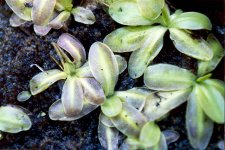
Attached is a photo of some of the wild plants I saw in Northern California.