

Could use a little clarification on this. I thought highland Nepenthes had to be in a tank for humidity but I also so lowland set ups. Should they both be in one or am I just confused?
TerraForums - Carnivorous Plant Community
You are using an out of date browser. It may not display this or other websites correctly.
You should upgrade or use an alternative browser.
You should upgrade or use an alternative browser.
Highland vs lowland
- Thread starter Plant Heathen
- Start date


Agreed. If anything you'll find that highlanders grow better in your average household conditions than a lowlander. Generally most plants can adapt to the humidity you'd find in a house. Most plants can adapt to humidities that are much lower than they'd experience naturally if light and temperature are ok. We have the heater going most of the time, dropping humidity down to 30-40% and the plants do fine.
So I'm guessing that highland wouldn't do well outside during the summer. It can get quite worm in CT.
Is it good for them to be outside or would the be better off inside?
The plants may survive, but they will not grow well during a hot summer. It's better to keep the temperatures down close to the normal growing conditions for the plants if at all possible.
Inside with AC it is
As an example of what a hot summer can do to a Nepenthes, here is a Nepenthes edwardsiana seedling. I acquired this plant at the beginning of October after it had endured a hot summer with the previous owner. From what I understand it basically didn't grow at all during the summer. After I received it, it produced that small leaf with no tendril pointing down in the picture as an after-effect of the heat. It seems to be back to normal now as you can see from the newest leaf.
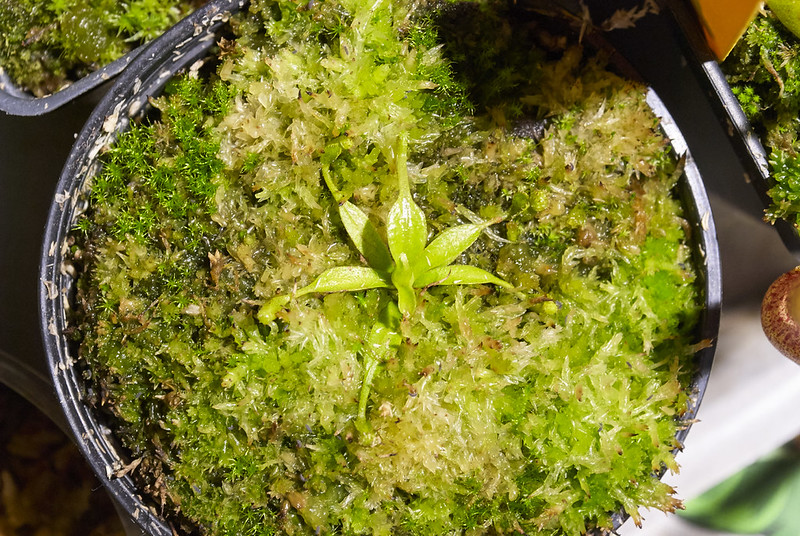 Nepenthes edwardsiana by Nimbulan, on Flickr
Nepenthes edwardsiana by Nimbulan, on FlickrAs an example of what a hot summer can do to a Nepenthes, here is a Nepenthes edwardsiana seedling. I acquired this plant at the beginning of October after it had endured a hot summer with the previous owner. From what I understand it basically didn't grow at all during the summer. After I received it, it produced that small leaf with no tendril pointing down in the picture as an after-effect of the heat. It seems to be back to normal now as you can see from the newest leaf.
My neps are definitely staying inside

This is interesting to me [MENTION=10989]nimbulan[/MENTION] because I am currently trying to grow highlanders in lowland temperatures. The plants are recent arrivals and a macrophylla was DOA, but once planted, they seem to be doing okay. I haven't had a single night with temperatures under 25C since they arrived, though coming months should get cooler including a few weeks in Jan that are under 20C. But so far, with nights in the upper 20s I have at least one alisaputrana, several seedlings that are either jamban or jamban hybrids (more likely), sibuyanensis, among other highland/intermediate plants. Seedlings have germinated and are growing.
The weather hasn't cooled as much as usual this year for the monsoon, and I was panicking, but they seem to be growing. They do get fairly regular misting and good light, but not direct sun after 11am or so. Sphagnum, net pots - whatever I can do to lower temps and add humidity, but cooling isn't super effective when ambient humidity is high. Also a lot of cloudy days for the next month or two at least. While this gets humidity high (90%+ most of the time), it torpedoes any evaporative cooling, since the wet bulb temperature is quite close to the regular temperature.
I have not seen this curled leaf thing in my conditions. Some seedlings come close to looking like this, but most eventually form teeny tiny tendrils, as I discovered to my delight. The Jamban seedlings are inflating new pitchers. The alisaputrana is growing a new leaf with a plump tendril tip - too early to say if it will actually form a pitcher yet, but it is looking as it should. No major signs of stress. Only one that got majorly stressed was N. mira - it accidentally got neglected in the scorching summer and was placed in a location where it didn't get any cooling from the mist and several hours of direct sun. It didn't die, but.... it suffered badly. Limping back slowly.
Makes me wonder if good light, high humidity and very cautious fertilization can boost the ability of highlanders to tolerate lowland conditions. I'd say cooling, but frankly, what is a few degrees here and there for a plant that doesn't even get its natural daylight temperatures of night?
The weather hasn't cooled as much as usual this year for the monsoon, and I was panicking, but they seem to be growing. They do get fairly regular misting and good light, but not direct sun after 11am or so. Sphagnum, net pots - whatever I can do to lower temps and add humidity, but cooling isn't super effective when ambient humidity is high. Also a lot of cloudy days for the next month or two at least. While this gets humidity high (90%+ most of the time), it torpedoes any evaporative cooling, since the wet bulb temperature is quite close to the regular temperature.
I have not seen this curled leaf thing in my conditions. Some seedlings come close to looking like this, but most eventually form teeny tiny tendrils, as I discovered to my delight. The Jamban seedlings are inflating new pitchers. The alisaputrana is growing a new leaf with a plump tendril tip - too early to say if it will actually form a pitcher yet, but it is looking as it should. No major signs of stress. Only one that got majorly stressed was N. mira - it accidentally got neglected in the scorching summer and was placed in a location where it didn't get any cooling from the mist and several hours of direct sun. It didn't die, but.... it suffered badly. Limping back slowly.
Makes me wonder if good light, high humidity and very cautious fertilization can boost the ability of highlanders to tolerate lowland conditions. I'd say cooling, but frankly, what is a few degrees here and there for a plant that doesn't even get its natural daylight temperatures of night?
Yes you can expand plants' temperature tolerance to some extent with humidity, fertilizer, and apparently keeping the soil drier than you otherwise would. There are always limits though, and the amount of time a plant is exposed to warmer temperatures is important. You may find that a plant that seems to be doing fine now may start to look unhappy in a year.Makes me wonder if good light, high humidity and very cautious fertilization can boost the ability of highlanders to tolerate lowland conditions. I'd say cooling, but frankly, what is a few degrees here and there for a plant that doesn't even get its natural daylight temperatures of night?
Regarding the plant I posted, I think the temperatures it was exposed to were much more extreme than you're seeing, more akin to what happened to your mira. It's also apparently a very weak clone and didn't survive too long for me.
For my part, I like to push the limits of my plants to see what they can handle. Always have a backup though in case it doesn't work.