

The locality is a nature reserve called "Swamp" near Doksy, Czechia. Drosera in general are very rare around here, since there is not much suitable habitat left. Last time I was looking for them in the Šumava national park, where they supposedly also grow, I did not find a single plant in the publicly accessible areas. This reserve also has restricted access, but these plants are fortunately growing on the very edge of the reserve in the first patch of sphagnum visible from the accessible path.
The habitat is a sparse forest of birch, alder and conifers, very wet soil and with plenty of sphagnum in the wettest areas. Drosera seem to only grow in the sphagnum. There is plenty of light getting to the ground and hitting the plants. The still moist sphagnum was noticeably warm to the touch. Forest undergrowth out of the sphagnum is dominated by Vaccinium blueberies, including the locally ubiquitous V. myrtillus and V. vitis-idaea, but also the relatively rare V. uliginosum (seen this one only very close to the swamp, seems to like it wet and cool).
The surrounding forest in the region is a dense pine plantation. There the soil was very dry, consisting of quarzite sand and some organics. Eroded paths through the forest are basicly just pure sand. This tells me that the geology makes the wetlands very nutrient poor.
The swamps are adjacent to a large recreational lake. Next to the swamps is also a (likely) fertilised meadow used for hay production. To my understanding there has been some work done to prevent the nutrient rich water from the surroundings from getting into the swamp.
Another wetland I've seen on the way there is currently too dry for Drosera. There was a small pond dug for water to collect in, probably to make the location suitable for cattle, but I'm not sure about the history of the place or owner's intentions. Also seen a dried out stream with Planorbius corneus shells.
Would prefer to spend more time there and take better photos, but I had to catch the train.
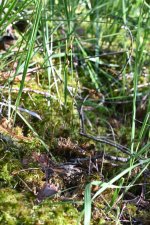
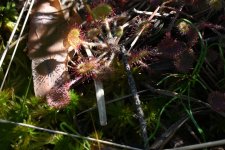
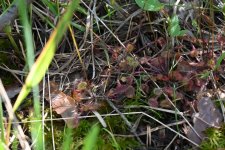
The habitat is a sparse forest of birch, alder and conifers, very wet soil and with plenty of sphagnum in the wettest areas. Drosera seem to only grow in the sphagnum. There is plenty of light getting to the ground and hitting the plants. The still moist sphagnum was noticeably warm to the touch. Forest undergrowth out of the sphagnum is dominated by Vaccinium blueberies, including the locally ubiquitous V. myrtillus and V. vitis-idaea, but also the relatively rare V. uliginosum (seen this one only very close to the swamp, seems to like it wet and cool).
The surrounding forest in the region is a dense pine plantation. There the soil was very dry, consisting of quarzite sand and some organics. Eroded paths through the forest are basicly just pure sand. This tells me that the geology makes the wetlands very nutrient poor.
The swamps are adjacent to a large recreational lake. Next to the swamps is also a (likely) fertilised meadow used for hay production. To my understanding there has been some work done to prevent the nutrient rich water from the surroundings from getting into the swamp.
Another wetland I've seen on the way there is currently too dry for Drosera. There was a small pond dug for water to collect in, probably to make the location suitable for cattle, but I'm not sure about the history of the place or owner's intentions. Also seen a dried out stream with Planorbius corneus shells.
Would prefer to spend more time there and take better photos, but I had to catch the train.
