Welcome to TerraForums — a long-running carnivorous plant community established in 2001. Register for free to join the conversation, ask questions, and connect with growers from around the world.
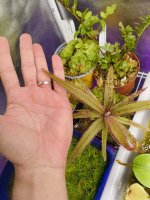
'Could be. The standard form of D. adelae can get pretty big if grown in less light so it's hard to say. Some have questioned whether or not a giant form actually exists. I've seen a plant that makes me believe that it does.
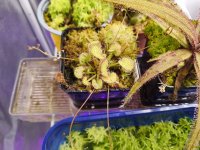
I wouldnt say its growing in low light conditions, which is precisely why Im suspicious of it being a potential giant variety. Notice its right next to my Nepenthes. Its probably receiving around 150-180 PPFD / 9 DLI
I love this species. It's like the spider plant of the carnivorous plant world. It will often produce baby plants at the end of it's flower stalks it basically spreads like a scrambling vine.
I wouldnt say its growing in low light conditions, which is precisely why Im suspicious of it being a potential giant variety. Notice its right next to my Nepenthes. Its probably receiving around 150-180 PPFD / 9 DLI
I say 'low light' in reference to most sundews which like very bright lighting. Nepenthes tend to like lower light levels in comparison. I have a very healthy N. 'Red Leopard' growing next to my African violets, for instance. I find it amazing that D. adelae is so adaptable when it comes to light levels.
This site uses cookies to help personalise content, tailor your experience and to keep you logged in if you register.
By continuing to use this site, you are consenting to our use of cookies.