
TerraForums - Carnivorous Plant Community
You are using an out of date browser. It may not display this or other websites correctly.
You should upgrade or use an alternative browser.
You should upgrade or use an alternative browser.

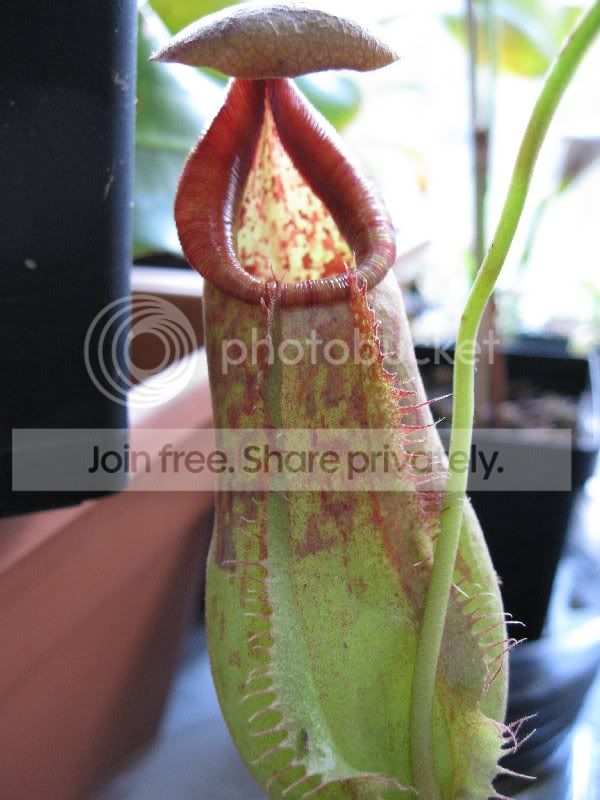
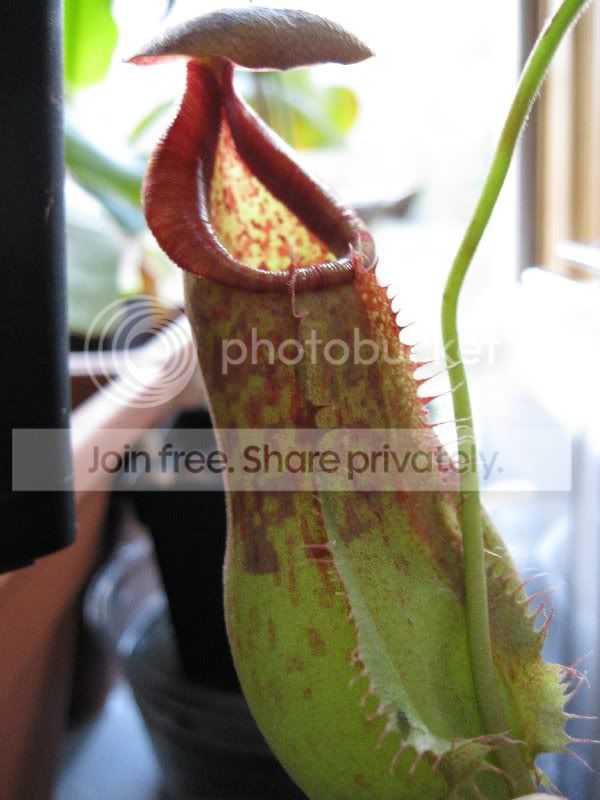


theyellowdart
sea bear returns!
Do you have a shot of the leaves?


maneatingmoo
Dog!
Well, I'm not very good at IDing anything, but the colors in the pitcher look a little like my sanguinea's. Reddish spots on the top half, greener on the bottom half. And those longer whisker things on the front.
Well, I'm not very good at IDing anything, but the colors in the pitcher look a little like my sanguine. Reddish spots on the top half, greener on the bottom half. And those longer whisker things on the front.
Nope not a sanguinea, I have one of those -- you can see mine here :
http://i159.photobucket.com/albums/t131/selkie630/IMG_0142.jpg
I am only posting the link so that t doesn't confuse the issue

theyellowdart
sea bear returns!
I was going to suggest a truncata hybrid, but the leaves don't match up.
It looks like it may have some veitchii or another wide peristomed Nepenthes mixed in with it. I can't really tell beyond that.
Did you purchase this plant from a local nursery?
Good luck
It looks like it may have some veitchii or another wide peristomed Nepenthes mixed in with it. I can't really tell beyond that.
Did you purchase this plant from a local nursery?
Good luck

DavyJones
Is ready to take this hobby to a whole new level
It seems like it might have some raff or thorelli in it.
As soon as I saw the leaves, I thought there was some Raff in it too.

Looks like the coccinea I used to grow.

S_Oregon_CP
Bio is my life!
the pitcher looks very similar to my N. truncata from Pasian Island. The leaves do not match up but truncata leaves do get long when the plant is more mature. If it is a hybrid this may be very hard to discern to any certainty.


im surprised no one has said N. x 'Judith Finn', thats my guess


Sam I want to ask you where you got the idea of this plant having thorelii in it. Don't go throwing out positive IDs unless there is more supporting evidence to say it is that. It looks like judith finn to me for the following reasons: leaf attachment, leaf shape, and tendril. The pitcher also looks like a young judith finn, or maybe one that is just a little weirded out. I see no evidence of thorelii in this plant what so ever. Judith finn is spathulata x veitchii, if that is indeed what this plant is.

EdaxFlamma
The Consuming Flame
I would agree with the Judith Finn elements as well but I think there is a little more in it than that. Spathulata is there but the spotting makes me think something else crept in. Judith Finn x 
Edax: i see your point
ive seen spotting on the inside of judith finn a couple times, it could be the way the light is hitting the pitcher causing the blotches to stand out a bit more? not sure.
ive seen spotting on the inside of judith finn a couple times, it could be the way the light is hitting the pitcher causing the blotches to stand out a bit more? not sure.
theyellowdart
sea bear returns!
Edax: i see your point
ive seen spotting on the inside of judith finn a couple times, it could be the way the light is hitting the pitcher causing the blotches to stand out a bit more? not sure.
Right, no spots on the outside with Judith Finn, only on the inside. So it is possible that you saw the inside blotching from the sun on the opposite side of the plant. (Edit: which looks to be happening in this picture.)
The outside is a definite pure green with pure red peristome, even when relatively young.